Scan our QR code to stay updated with the recent news and upcoming events.
Scan our QR code to stay updated with the recent news and upcoming events.

Zhang Lehua, an artist known for his exceptional talent and innovative approach, has captivated audiences worldwide with his thought-provoking artworks. Born in Shanghai in 1985, Zhang Lehua's artistic journey has taken him on a remarkable path of exploration and creativity.
Zhang Lehua's passion for art began at an early age, leading him to pursue his education at prestigious institutions. He attended HuaShan Art Vocational School in Shanghai from 2000 to 2004, where he honed his artistic skills. He furthered his studies in New Media Art at the China Academy of Art in Hangzhou from 2004 to 2008, where he delved into the realm of contemporary art.
Zhang's artistic practice has focused on video, installation, performance, photography, and more recently painting, even though Lehua argues he feels more creative using new media. He has developed a series of poster and canvas paintings that derive their tone and aesthetic from high-school education posters and material.
Throughout his career, Zhang Lehua has showcased his talent through numerous solo and group exhibitions around the world. His solo projects, such as Love in a Golden Bowl: Zhang Lehua Solo Exhibition, Art+ Shanghai Gallery, The World’s Longing for Lushan, Vanguard Gallery, Shanghai "Romance in LuShan Cinema" in Shanghai, China, “The interpreter who interrupts” Enrique Navarro Gallery, Paris, and "Paint from Cinema" at ZeYi Cinema & Imagokinetics Lab in Hangzhou, have garnered critical acclaim for their innovative concepts and artistic brilliance.
Zhang Lehua's artworks have been featured in prominent galleries and art centers globally as a Groninger Museum in Holland and the Tampa Museum of Art in Florida, USA, among others.
As a founding member of the Double Fly Art Centre, a new media art collective established in 2008 and active in Shanghai, Hangzhou, and Beijing, Zhang Lehua also took part in the Armory in New York in 2014 (Space Station booth), in "Double Fly 108 Deaths" at chi K11 Art Museum in Shanghai, China, and "The Sun" at V Art Center in Shanghai, China.
Recognized for his exceptional talent and contributions to the art world, Zhang Lehua has received several nominations and awards. Notably, he was nominated for the A Nomination International Touring Exhibition of Young Media Artists, co-organized by Chronus Art Center, ZKM | Center for Art and Media, and Nam June Paik Art Center. His artworks have also been nominated for the Art Sanya HuaYu Youth Award and the Pierre Huber Creation Prize.
Many art critics consider Zhang Lehua the William Blake of post-modernism. This comparison is not only based on the recurring theme of adolescence maturing in their works, but also on their shared defiance against authority. While Blake was deeply immersed in theological literature and harbored intense disdain for the Established Church, Lehua holds dissident views against mainstream societal thoughts. Both artists' works reflect raw honesty, but Lehua's creations place a heavier emphasis on colloquial satirical elements. Zhang's works can be described as rustic and humorous, displaying a style that defies strict definition. This is particularly evident in his series of paintings modeled after propaganda posters. His satirical cartoon series emulates the tone and visual aesthetics of public service announcements, touching upon subjects like the sexual behaviors of Chinese teenagers and children from transnational marriages. These paintings bear a resemblance to the old bulletin boards and propaganda posters prevalent in China before the 1980s, but the content reflects contemporary socio-cultural issues. Zhang is a master of visual styles and strives to unveil raw societal truths through his unique style, and he has succeeded.
Zhang Lehua, an artist known for his exceptional talent and innovative approach, has captivated audiences worldwide with his thought-provoking artworks. Born in Shanghai in 1985, Zhang Lehua's artistic journey has taken him on a remarkable path of exploration and creativity.
Zhang Lehua's passion for art began at an early age, leading him to pursue his education at prestigious institutions. He attended HuaShan Art Vocational School in Shanghai from 2000 to 2004, where he honed his artistic skills. He furthered his studies in New Media Art at the China Academy of Art in Hangzhou from 2004 to 2008, where he delved into the realm of contemporary art.
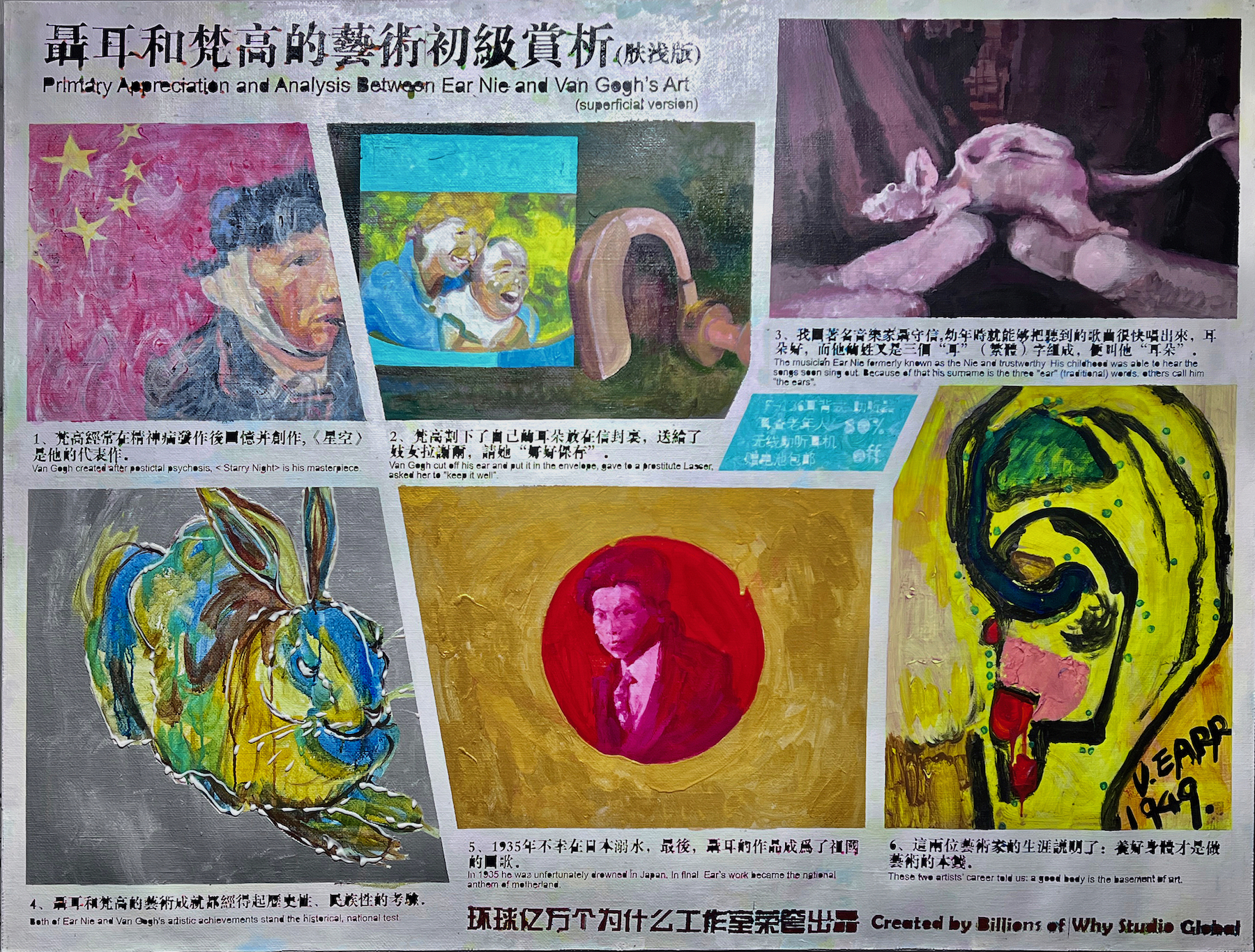
Zhang's artistic practice has focused on video, installation, performance, photography, and more recently painting, even though Lehua argues he feels more creative using new media. He has developed a series of poster and canvas paintings that derive their tone and aesthetic from high-school education posters and material.
Throughout his career, Zhang Lehua has showcased his talent through numerous solo and group exhibitions around the world. His solo projects, such as Love in a Golden Bowl: Zhang Lehua Solo Exhibition, Art+ Shanghai Gallery, The World’s Longing for Lushan, Vanguard Gallery, Shanghai "Romance in LuShan Cinema" in Shanghai, China, “The interpreter who interrupts” Enrique Navarro Gallery, Paris, and "Paint from Cinema" at ZeYi Cinema & Imagokinetics Lab in Hangzhou, have garnered critical acclaim for their innovative concepts and artistic brilliance.
Zhang Lehua's artworks have been featured in prominent galleries and art centers globally as a Groninger Museum in Holland and the Tampa Museum of Art in Florida, USA, among others.
As a founding member of the Double Fly Art Centre, a new media art collective established in 2008 and active in Shanghai, Hangzhou, and Beijing, Zhang Lehua also took part in the Armory in New York in 2014 (Space Station booth), in "Double Fly 108 Deaths" at chi K11 Art Museum in Shanghai, China, and "The Sun" at V Art Center in Shanghai, China.
Recognized for his exceptional talent and contributions to the art world, Zhang Lehua has received several nominations and awards. Notably, he was nominated for the A Nomination International Touring Exhibition of Young Media Artists, co-organized by Chronus Art Center, ZKM | Center for Art and Media, and Nam June Paik Art Center. His artworks have also been nominated for the Art Sanya HuaYu Youth Award and the Pierre Huber Creation Prize.
Many art critics consider Zhang Lehua the William Blake of post-modernism. This comparison is not only based on the recurring theme of adolescence maturing in their works, but also on their shared defiance against authority. While Blake was deeply immersed in theological literature and harbored intense disdain for the Established Church, Lehua holds dissident views against mainstream societal thoughts. Both artists' works reflect raw honesty, but Lehua's creations place a heavier emphasis on colloquial satirical elements. Zhang's works can be described as rustic and humorous, displaying a style that defies strict definition. This is particularly evident in his series of paintings modeled after propaganda posters. His satirical cartoon series emulates the tone and visual aesthetics of public service announcements, touching upon subjects like the sexual behaviors of Chinese teenagers and children from transnational marriages. These paintings bear a resemblance to the old bulletin boards and propaganda posters prevalent in China before the 1980s, but the content reflects contemporary socio-cultural issues. Zhang is a master of visual styles and strives to unveil raw societal truths through his unique style, and he has succeeded.